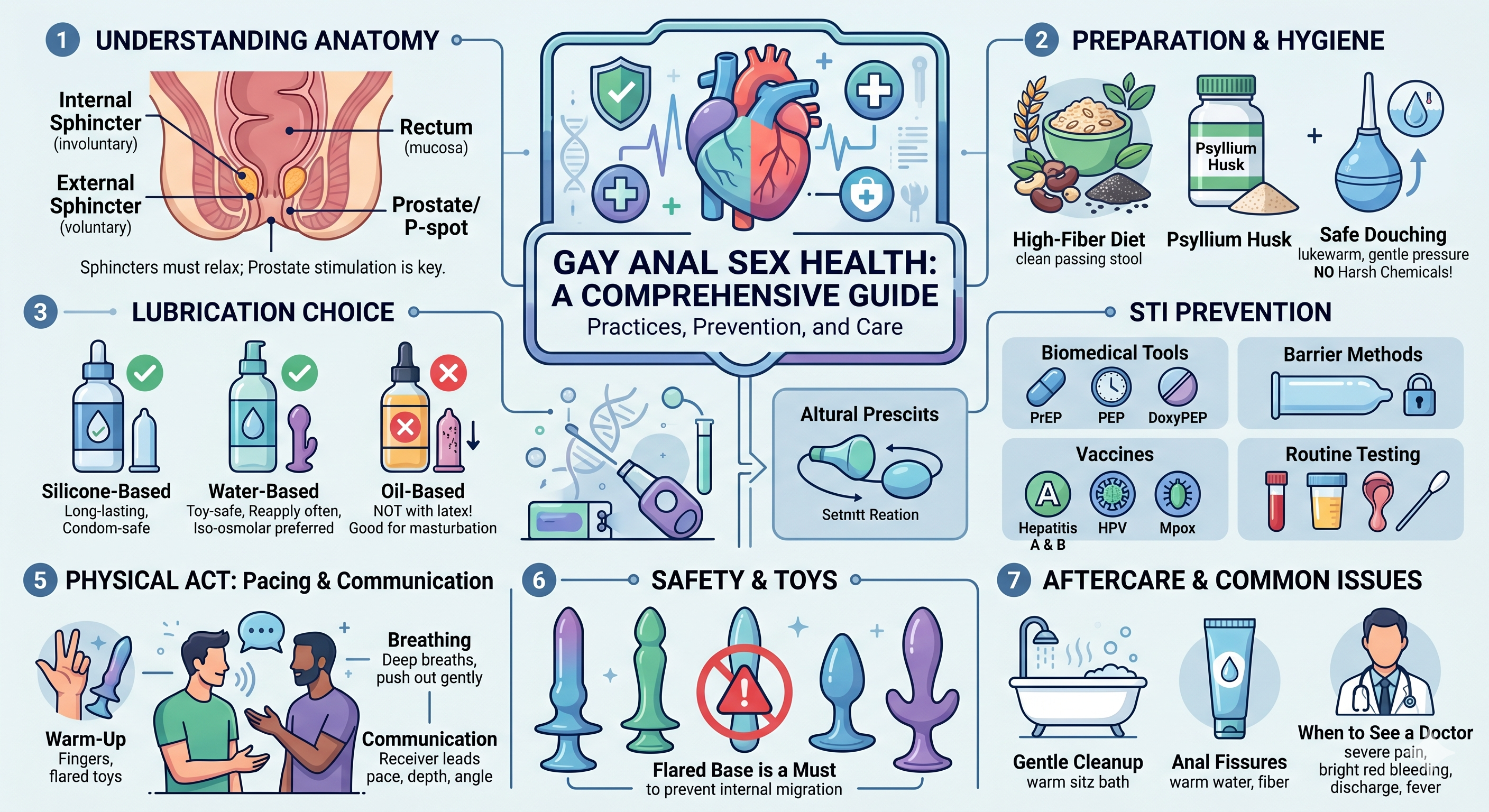
Engaging in anal sex can be a fulfilling and highly pleasurable part of a healthy sex life. However, because the anatomical structure of the rectum and anus differs significantly from the vagina—most notably in that it is not self-lubricating and its primary biological function is the expulsion of waste—it requires specific care, preparation, and knowledge. Prioritizing your physical health not only prevents injuries and infections but also significantly enhances pleasure and intimacy. This guide covers everything from anatomy and preparation to sexually transmitted infection (STI) prevention and aftercare.
To engage in anal sex safely and comfortably, it is essential to understand the underlying anatomy.
The Sphincters: The anus is controlled by two distinct bands of muscle. The internal sphincter is involuntary; it remains closed to hold in gas and stool and only relaxes reflexively. The external sphincter is under your voluntary control (the muscle you squeeze to hold it in). Both must be relaxed for comfortable penetration.
The Rectum: This is the chamber just past the anal sphincters. Its lining (mucosa) is delicate, highly absorbent, and thinner than vaginal tissue, making it more susceptible to micro-tears (fissures) if adequate lubrication is not used.
The Prostate: Often referred to as the "P-spot" or male G-spot, the prostate gland is located about two inches inside the rectum, toward the front of the body (towards the base of the penis). Stimulation of the prostate can lead to profound sexual pleasure and intense orgasms.
Many people feel anxiety regarding cleanliness during anal sex. A proactive approach to diet is the most effective way to manage this.
A high-fiber diet is the foundation of anal health. Soluble fiber binds with water to create well-formed, clean-passing stools, leaving the rectum naturally empty and clean.
Dietary Sources: Oats, beans, lentils, chia seeds, and leafy greens.
Supplements: Many people who engage in anal sex take a daily psyllium husk supplement. Psyllium is highly effective at sweeping the digestive tract clean. Ensure you drink plenty of water when taking fiber supplements, as fiber requires hydration to work properly.
Douching (flushing the rectum with water) is completely optional. If you choose to douche, it must be done safely to avoid damaging the rectal lining.
Use the Right Equipment: Use a specialized anal bulb or a shower attachment with an adjustable flow regulator.
Water Temperature and Pressure: Use lukewarm water. The water pressure should be gentle; high pressure can push water too far up into the colon, which can cause cramping and actually bring down more stool.
Avoid Chemicals: Never use soaps, alcohol, or harsh chemicals inside the rectum. These strip the natural mucosal lining, destroy healthy gut bacteria, and dramatically increase the risk of chemical burns and STI transmission. Plain water or isotonic saline is best.
Less is More: Only a small amount of water is needed to clean the lower rectum. Chronic over-douching can lead to chronic constipation or an irritated bowel.
Because the anus does not produce its own lubrication, artificial lube is mandatory. Saliva is wholly insufficient and can introduce unwanted bacteria into the rectum.
Silicone-Based Lubricant: The gold standard for anal sex. It is highly slippery, long-lasting, does not dry out, and is safe to use with latex and polyurethane condoms. Note: Do not use silicone lube with silicone toys, as it will degrade the toy's surface.
Water-Based Lubricant: Safe for all toys and condoms. However, it dries out and is absorbed by the body, requiring frequent reapplication.
Pro-Tip: Look for iso-osmolar (or osmolality-balanced) water-based lubes without glycerin. Hyperosmolar lubes draw water out of the rectal cells, causing cell death and increasing the risk of STI transmission.
Oil-Based Lubricant: (e.g., coconut oil, vaseline). These are excellent for masturbation or mutual masturbation but must never be used with latex condoms, as oil breaks down latex almost instantly, leading to condom failure.
The highly absorbent nature of the rectal lining makes it an efficient pathway for the transmission of STIs, particularly HIV. A multi-layered approach to sexual health is highly recommended.
Condoms: Still the most effective method for preventing the exchange of bodily fluids and reducing the risk of HIV, gonorrhea, chlamydia, and syphilis.
PrEP (Pre-Exposure Prophylaxis): A daily pill (like Truvada or Descovy) or a bi-monthly injection (Apretude) that, when taken as prescribed, is up to 99% effective at preventing the sexual transmission of HIV.
PEP (Post-Exposure Prophylaxis): An emergency regimen of antiretroviral medicines taken after potential exposure to HIV. It must be started within 72 hours of exposure.
DoxyPEP: A relatively new protocol where taking a specific dose of the antibiotic doxycycline within 72 hours after condomless sex can significantly reduce the risk of contracting bacterial STIs (chlamydia, gonorrhea, and syphilis). Consult an infectious disease specialist or sexual health clinic for a prescription.
Vaccines: Ensure you are vaccinated against Hepatitis A and B, HPV (Human Papillomavirus, which can cause anal warts and anal cancer), and Mpox.
Routine Testing: If you have multiple partners, get a comprehensive STI screening every 3 to 6 months. This should include a blood test (for HIV and syphilis), a urine test, and throat and rectal swabs (as gonorrhea and chlamydia can live asymptomatically in the throat and rectum).
Anal sex should never be inherently painful. While a feeling of "fullness" or slight stretching discomfort is normal at the very beginning, sharp pain is a signal to stop immediately.
Warm-Up: Begin with external massage, rimming (using a dental dam if STI status is unknown), or fingers. Gradually increasing size using fingers or appropriately sized, flared-base toys helps the internal sphincter realize it is safe to relax.
Breathing: The external sphincter tightens when you hold your breath. Focus on deep, slow belly breaths. A common technique is to push out gently (as if bearing down for a bowel movement) as penetration occurs; this naturally forces the sphincters to open.
Communication: Consistent communication is vital. The receiving partner must dictate the pace, depth, and angle.
If incorporating sex toys, there is one absolute, non-negotiable medical rule: Any object inserted into the anus must have a flared base or a secure handle. The rectum actively pulls things inward via peristalsis (involuntary muscle contractions). An object without a flared base can easily get sucked up into the colon, requiring an emergency room visit for surgical removal.
Post-sex care is just as important as preparation.
Cleaning Up: Wash the external area gently with warm water and mild, unscented soap. Do not douche immediately after sex, as the tissue is already inflamed and micro-abrasions may be present.
Anal Fissures: These are small, painful tears in the tissue lining the anus, often caused by inadequate lubrication or rushing. They typically heal on their own in a few days. Treatment includes warm sitz baths, high-fiber diets, and abstaining from anal play until completely healed.
Hemorrhoids: Swollen veins in the lowest part of the rectum and anus. They can be aggravated by rough sex or heavy douching. Over-the-counter creams can help, but severe cases require a doctor's evaluation.
When to See a Doctor: Seek medical attention if you experience severe, unyielding pain, continuous bright red rectal bleeding that doesn't stop, a foul-smelling discharge, or an unexplained fever following anal sex.
By combining open communication, anatomical awareness, proper lubrication, and modern biomedical STI prevention, anal sex can be a safe, healthy, and highly rewarding experience.

© 2026 gayhotvod.xyz Free Hot Gay Porn Video Streaming HD Tube. All Rights Reserved by GayHotVod. Please note this is 18+ ONLY Website.
All models appearing on this website are 18 years or older. By entering this site you swear that you are of legal age in your area to view adult material and that you wish to view such material.
No Content